Cops or Clinicians: What is the role of law enforcement?
Focusing on Words, Actions and Behaviors
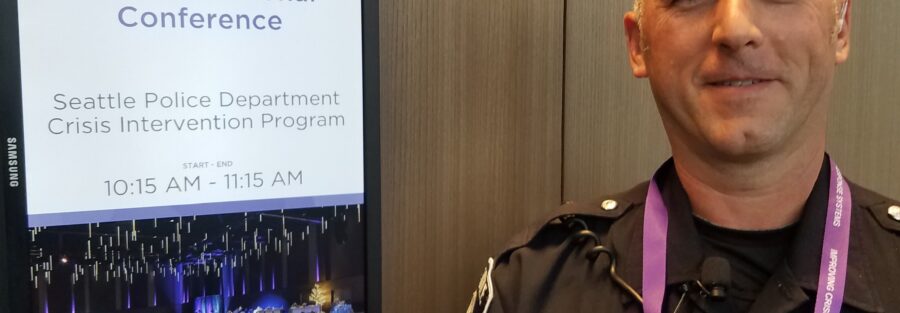
Lt. Eric Pisconski (Ret) / Seattle Police Department
Tac-D Solutions
There has been an on-going conversation touching communities across the nation related to mental health and law enforcement that has been growing over the last 10-years. Specifically, what is the role of law enforcement regarding interactions with individuals experiencing mental health issues. There is often fundamental disagreement if police officers should be responding at all to calls involving individuals experiencing some type of behavioral or mental health crisis. Inevitably, police officers will still either respond to or on-view these types of situations – it is not a zero-sum game. The discussions often lean toward more training for police so they can be as effective as mental health professionals. The implication is often that if law enforcement had enough mental health related training, it would reduce, or eliminate, the need to use force – specifically deadly force. The Washington Post has collected data for the last decade and estimates nearly 25% of law enforcement fatal shootings involved persons identified with mental illness (the person was categorized as un-armed in less than 5% of the incidents). Let’s examine some of the information that brought law enforcement to this societal crossroads and their role moving forward.
Psychotropic medications designed to better manage mental illness became readily available during in the 1950’s, and the first push toward deinstitutionalization began. In 1955, Congress established the Joint Commission on Mental Illness and Health to examine issues related to the mentally ill. There was a concerted effort to deinstitutionalize mental health care and move it toward a system of community-based resources. This culminated in President Kennedy’s 1963 Community Mental Health Act; and combined with parts of the 1964 Civil Rights Act, it laid the foundation for state-based civil commitment guidelines. Since that time, the responsibility of primary interactions with those experiencing mental health related issues has fallen largely on the role of law enforcement.
According to the DOJ’s Bureau of Justice Statistics, there is 1 sworn officer for approximately every 415 residents nationally[i]. Approximately 70% of Agencies have fewer than 24 full-time sworn officers. The average training academy for police officers across the country, excluding any field training component, is approximately 806 hours or about 20 weeks[ii]. Training generally includes topics such as patrol procedures, legal guidelines, communications, first aid, driving, firearms, defensive tactics, use of force and investigations; some academies also include basics of crisis intervention. Now let’s compare the average training time to be credentialed as a ‘Mental Health Professional’ – obtaining a master’s degree in social work. Depending on the school and program, it takes 4-years for a Bachelor and another 1 – 2 years for a Master’s degree; not including field work.
Is it reasonable to expect that law enforcement also take on the role of mental health care clinicians and/or case managers?
The role of law enforcement is exactly that, enforcement of the law; with a primary focus on life safety. So, how should we incorporate these competing interests into ‘how we handle calls’? Law enforcement is generally operating behind the power curve; and tends to be reactionary by nature. Police officers do not know when or where the next call will be dispatched, what or who it will involve and (rarely) if the individual they will encounter is currently experiencing a crisis or suffers from a mental health issue. Upon arrival to a call, they must first make every effort to address any immediate threats and establish scene control. The goal is to slow things down, assess the situation and attempt to gain voluntary compliance with individuals who might be experiencing a crisis or suffering from mental health issues. However, law enforcement is often required make split-second decisions related to use of force and do not always have the luxury of time usually associated with a clinical setting. Once safe and reasonable, their role should be to function as a ‘Rosetta Stone’ of sorts, assessing an individual’s immediate needs and connecting them to the most appropriate service providers.
Should diagnosis be the focus for law enforcement?
For the purposes of law enforcement, an individual’s specific diagnosis is irrelevant. In any encounter, officers will assess the situation and base their response on a subject’s words, actions and behaviors. Those observable attributes are entirely more valuable in guiding the response by law enforcement than a specific clinical diagnosis. This philosophy is not only applicable to a traffic stop or disturbance, but also exactly how officers should assess incidents with persons experiencing crisis events or suffering from mental illness. Cops cannot also be clinicians, period. The latest edition of the Diagnostic and Statistical Manual of Mental Disorders (DSM-V) contains approximately 300 disorders with dozens of additional ‘subtypes’. The situation compounds exponentially when you add comorbidity and substance abuse addictions. Expecting law enforcement to be marginally familiar with all the possible diagnoses is comparable to asking that individual officers be fluent in every language they encounter and not need a translator. However, with some basic training, law enforcement can learn to recognize signs and symptoms often related to mental health issues, become familiar with viable skills and techniques for interacting with those in individuals and understand how to incorporate that into an overall Tactical De-Escalation approach utilizing the principles of Time, Distance and Shielding. By focusing on the words, actions and behaviors of an individual, law enforcement can implement a ‘best practice’ approach to these situations.
Developing some type of Response Plan for high-utilizers is imperative.
There are many terms floating around describing those disproportionate utilizers of 911 services – “regulars”, “frequent flyers”, “high utilizers”, etc. The commonality is that it refers to individuals having a disproportionate number of interactions with 911 services rooted specifically in their mental health issues. Incarceration will generally not benefit these individuals. Exploring options aside from the hospital or jail (ie – taking a more holistic approach) and finding alternatives to the criminal justice system will decrease their interactions with law enforcement. The utilization of ‘crisis plans’ is not new to mental health service providers; they are often used by ER hospital staff, case managers and some fire departments as well. Incorporating this type of an individually tailored ‘Response Plan’ is an essential piece to providing a consistent, balanced and holistic approach when engaging with people experiencing on-going mental health issues. The most effective plans are developed by incorporating the previous words, actions and behaviors of an individual and collaborating with their current service provider or case manager (possibly even family members) to determine a plan of action and redirect them to available resources.
In closing, remember that the role of law enforcement is constantly evolving with case law, technology and the expectations of the communities we serve. It is also clear that law enforcement interactions with individuals experiencing mental health or crisis related issues are embedded into our daily operations. It is not appropriate for cops to be tasked as clinicians. However, it is essential for officers to focus on the words, actions and behaviors associated with an individual; and when safe and feasible, implement a Tactical De-Escalation approach to those interactions. In doing so, responding officers can strive to gain voluntary compliance during encounters and work toward a holistic long-term approach, to include the utilization of tailored Response Plans, and redirect individuals back to the most appropriate services.
Obviously, 100% de-escalation and complete voluntary compliance will not be achieved in every encounter. However, pursuing a Tactical De-escalation approach will strengthen your articulation when reasonable, necessary and proportional force is required.
[i] US Department of Justice – Bureau of Justice Statistics: Census of State and Local Law Enforcement Agencies, 2018. Oct 2022 (https://bjs.ojp.gov/library/publications/census-state-and-local-law-enforcement-agencies-2018-statistical-tables)
[ii] US Department of Justice – Bureau of Justice Statistics: State and Local Law Enforcement Training Academies and Recruits, 2022. Nov 2024 (https://bjs.ojp.gov/library/publications/state-and-local-law-enforcement-training-academies-and-recruits-2022)