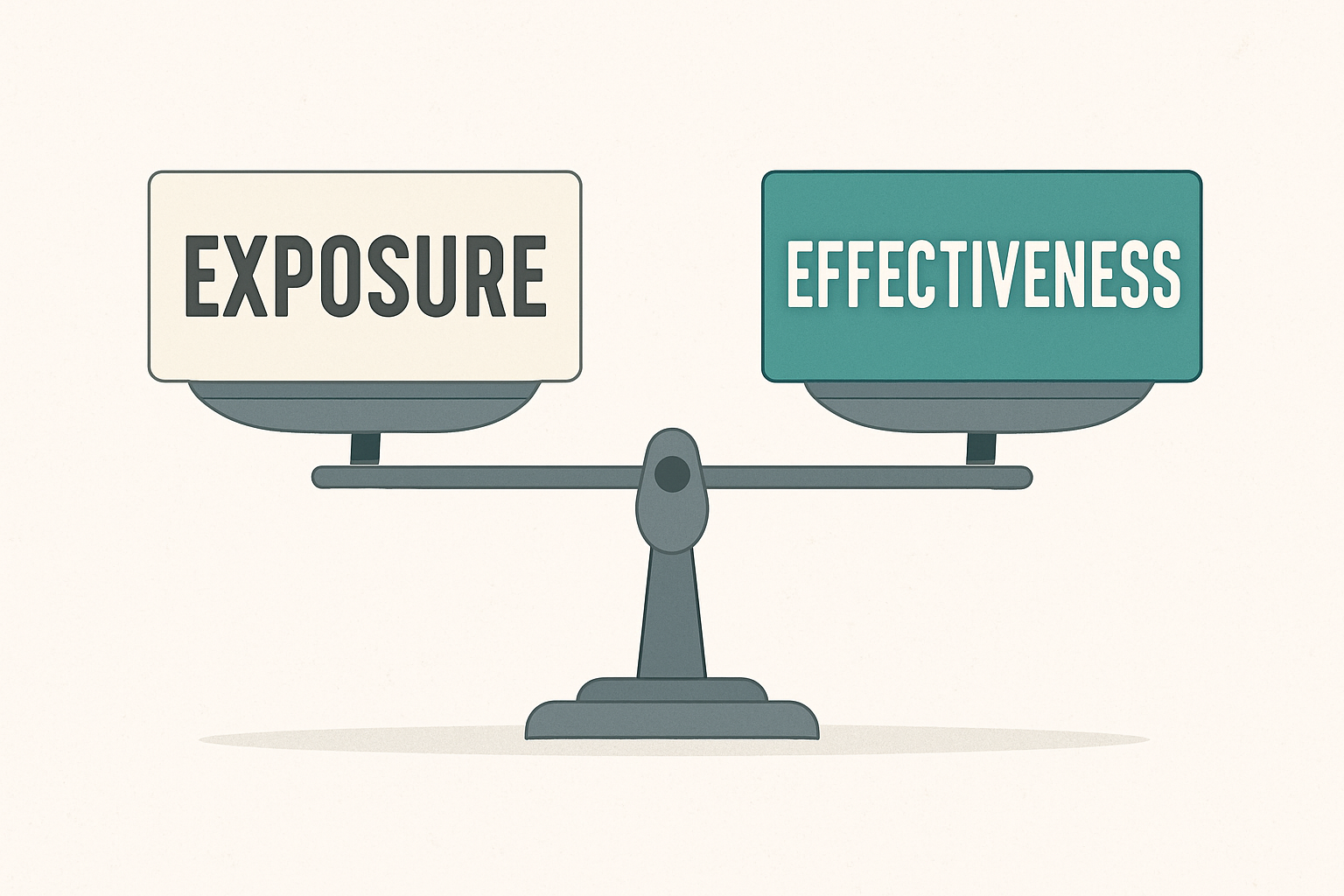
Exposure vs Effectiveness
Finding a balance to achieve the desired outcome
Lt. Eric Pisconski (Ret) / Seattle Police Department
Tac-D Solutions – Founder
Where is the balance between safety and positive outcomes?
Life is about give-and-take. While growing up or entering adulthood, you have likely had someone give you similar advice. Often that wisdom came from a parent, mentor, coach or a boss. As our interpersonal skills develop, we inherently understand the concepts of compromise and negotiation. While juxtaposing idealism vs reality, the classic Rolling Stones[i] song summarized it well – “You can’t always get what you want. But if you try sometimes, well, you just might find, you get what you need”. This is not about settling for less or accepting mediocracy. It is the recognition that principles and preconceived notions must sometimes be adjusted or modified when confronted with a changing landscape. Poet Robert Burns[ii] coined the phrase, “the best laid schemes o’ mice an’ men” (eventually adapted as the title of Steinbeck’s 1937 novel[iii] ‘Of mice and men’). This turn of phrase is often referenced when reflecting on uncertainty, humility and the limits of human control.
While a quick and hasty plan is better than no plan at all, training for contingencies and instilling adaptability are sound principles. Life safety is the primary directive of law enforcement. Making the scene safe upon arrival is the first operating principle. However, we cannot guarantee our personal safety nor the safety of the public in every possible scenario. Law enforcement is acutely aware that we do not have exclusive input on the decision-making during an encounter – the subject (and, to a certain extent, the public at large) has a voice and free will to make choices as well.
Assessing the situation
Law enforcement is often required to assess the totality of circumstances in mere seconds to determine what response is safe and feasible, if exigent circumstances exist, or if there is an immediate life safety issue. Officers must take in all the available information to determine initial responses, potential tactical options, and resources needed. We evaluate our surroundings to gauge cover versus concealment, angles and areas of responsibility, and potential avenues of egress. The concept of weighing exposure versus effectiveness is not new for law enforcement professionals as they are constantly evaluating and reassessing dynamic situations.
While numerous assessment models exist in the realm of law enforcement, all include some variation of Exposure vs Effectiveness. Tactical strategies come down to, “what do I give up, what do I gain?” while trying to tip scales in our favor and maintain the tactical advantage. However, sometimes we concede exposure for the advantage of effectiveness. Consider a basic interview stance and positioning during contact and cover as a basic example. You want to be close enough to react – such as trapping a hand reaching for a potential weapon or blocking a lunge, but far enough away that you are not easily kicked or headbutted. Is there still risk? Yes. Am I in a position to mitigate the threat? Yes. After Action Reports and Hotwash debriefs are imperative to building competence and effectiveness. Remember the golden rule, don’t let good outcomes reinforce bad tactics.
Utilizing Tactical De-escalation
As discussed in previous articles, de-escalation is merely the use of words and actions to reduce a heightened emotional and physical state, with the goal of facilitating a calm, rational interaction. Tactical De-Escalation combines the two principles of police tactics and de-escalation; providing tools and techniques to recognize and navigate crisis situations. There is no guaranteed approach to ensure every encounter is successfully de-escalated. Implementing the strategies of tactical de-escalation will ensure that practitioners have the tools available to mitigate emotionally charged situations in a safe manner.
Everything in your response, from arrival to resolution, is inclusive of Tactical De-Escalation. It includes a strong officer presence, appropriate team and individual tactics and approach – to include the implementation of Time, Distance, and Shielding principles, threat assessment and identification, and verbal engagement.
What happened to ‘Ask – Tell – Make’?
Sure, growing up I had my run-ins with cops… whether a traffic stop (of course I wasn’t speeding), or at an improvised social gathering (allegedly there was a keg), but I always had a healthy respect for law enforcement. Of course, later I discovered ‘choir practice’ and where all the confiscated alcohol was taken; but that is a story for another time. As a rookie you discover that ‘officer presence’ is an extremely important element. Not only does it contribute to officer safety, but it becomes the embodiment of your authority. Some people will initially respect the uniform at face value, but that will evaporate quickly with a lack of presence or a badge-heavy approach.
Tac Officers in the academy would discuss officer presence and getting people to obey lawful commands. The rule was simple, “Ask, Tell, Make”. It seemed pretty straightforward. If I had the legal authority and lawful purpose, then you needed to follow my commands or there would be consequences. Unfortunately, that black-and-white approach does not always hold up in the grey world. Sometimes, it is easier to talk them into handcuffs rather than fight them into cuffs. Again, balancing exposure and effectiveness.
Putting it all together
As we balance procedural justice, Constitutional policing, and life safety, can ‘Ask, Tell, Make’ be modified into ‘Request, Inform, Effectuate’? The perspective of, ‘you stopped being in charge the moment I showed up’ still holds true. Each encounter must be assessed and evaluated based on the totality of circumstances. In some cases, immediate action is necessary and we fix bayonets. For everything else, law enforcement attempts to form a tactical response that will achieve the desired outcome in the safest manner possible. Balancing exposure and effectiveness is part of every contact or incident response; from a simple traffic stop to an active shooter call. Employing tactical de-escalation principles, slowing things down, leveraging Time, Distance, and Shielding lead to safer outcomes and allow consideration for exposure versus effectiveness.
[i] Jagger, M., & Richards, K. (1969). You can’t always get what you want [Song]. On Let it bleed. Decca Records.
[ii] Burns, R. (1785). To a mouse. Poetry Foundation. https://www.poetryfoundation.org/poems/43816/to-a-mouse-56d222ab36e33
[iii] Steinbeck, J. (1993). Of mice and men. Penguin Books.